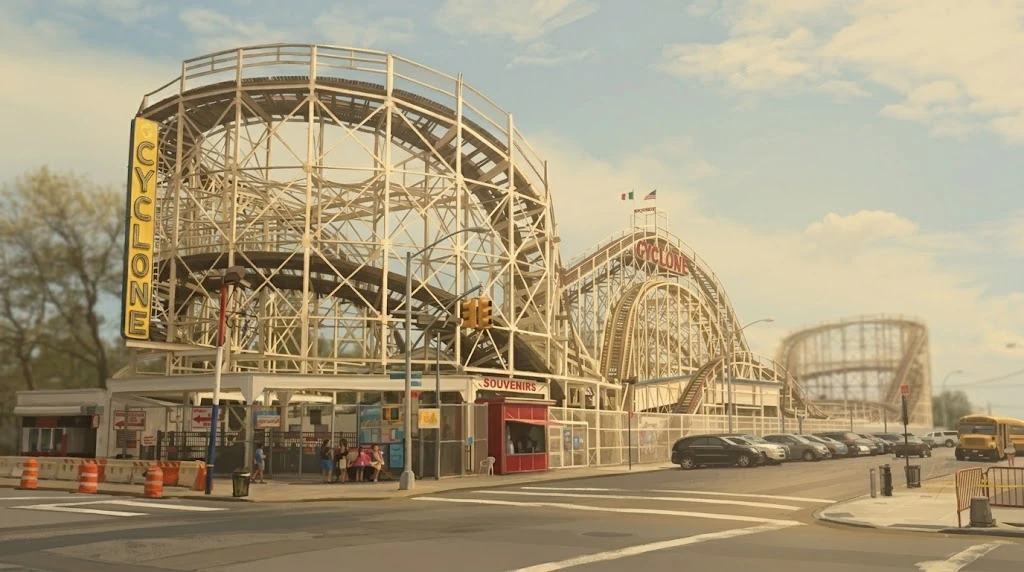
Most of the coasters that defined the early American thrill ride are long gone. The Coney Island Cyclone is the rare one that's still here, still running on the same Brooklyn corner where it opened on June 26, 1927, and that survival is a big part of why it matters.
The ground it sits on is about as historic as the ride. In 1884, LaMarcus Adna Thompson opened the Switchback Railway on nearly the same plot, widely recognized as the first purpose-built amusement coaster in the country. It crawled along at six miles an hour and riders had to climb a tower to board, but even then it was still popular enough to pay for itself in three weeks. Coney Island spent the next forty years as the laboratory of the American roller coaster, and by the time the brothers Jack and Irving Rosenthal wanted a ride to compete with the nearby Thunderbolt and Tornado, the plot had already cycled through the Giant Racer. They put up $100,000 and hired Vernon Keenan, then the country's leading coaster designer, to build something better, with Harry C. Baker supervising the construction.
What Keenan drew is a compact twister, which is a layout where the track folds tightly back on itself rather than running straight out and back. The numbers still hold up: 2,640 feet of track, twelve drops, six fan turns, about sixty miles an hour, and a first drop of roughly 85 feet at 58.1 degrees, which the city's landmark report memorably describes as "just twenty-two degrees off the perpendicular." The drop runs so close to the structure overhead that it produces the classic headchopper effect, and the whole circuit takes about a minute and fifty seconds on momentum alone once the lift lets go. Charles Lindbergh, two years off his transatlantic flight, reportedly called a ride on it "a greater thrill than flying an airplane at top speed."
Then comes the part that nearly erased it. Coney Island's golden age did not survive the postwar decades, and by 1969 New York City had bought the Cyclone for $1.2 million, intending to hand the land to the adjacent aquarium. In 1972 the aquarium announced plans to replace the coaster with a swamp display, and under city ownership the ride piled up 101 safety violations. But a "Save the Cyclone" campaign formed to fight it. The owners of Houston's AstroWorld even looked at buying the ride and moving it to Texas, found it too expensive, and built a replica they called the Texas Cyclone instead. The real save came in 1975, when Dewey and Jerome Albert of the neighboring Astroland park leased it, spent $60,000 refurbishing it, and reopened it that July. The president of the Gravesend Historical Society put it best: "Unlike the Dodgers, the Cyclone will never leave Brooklyn."
The protection became official over the following decade and a half. The New York City Landmarks Preservation Commission designated it a city landmark on July 12, 1988, concluding that because modern building codes no longer allow new timber-supported coasters, the Cyclone is "irreplaceable." It was added to the National Register of Historic Places on June 26, 1991, exactly sixty-four years to the day after it opened, and the American Coaster Enthusiasts, the preservation-minded group we know as ACE, named it a Roller Coaster Landmark in 2002. There's a nice loop in the next chapter, too: when Luna Park brought in Great Coasters International to overhaul the ride in the 2010s, GCI's co-founder Michael Boodley had personally ridden the Cyclone 1,001 times back in 1975.
Nearly a hundred years on, it still runs at Luna Park one train at a time, stopped by manually operated skid brakes rather than a ride computer, its white track and 45-foot CYCLONE sign as much a part of the Brooklyn skyline as ever. The landmark report quoted historian Gary Kyriazi, and it still lands: New Yorkers should consider the Cyclone "as valuable as the Statue of Liberty or the Empire State Building." For a wooden coaster from 1927, we'd say that's a fair accounting of what it survived to become.