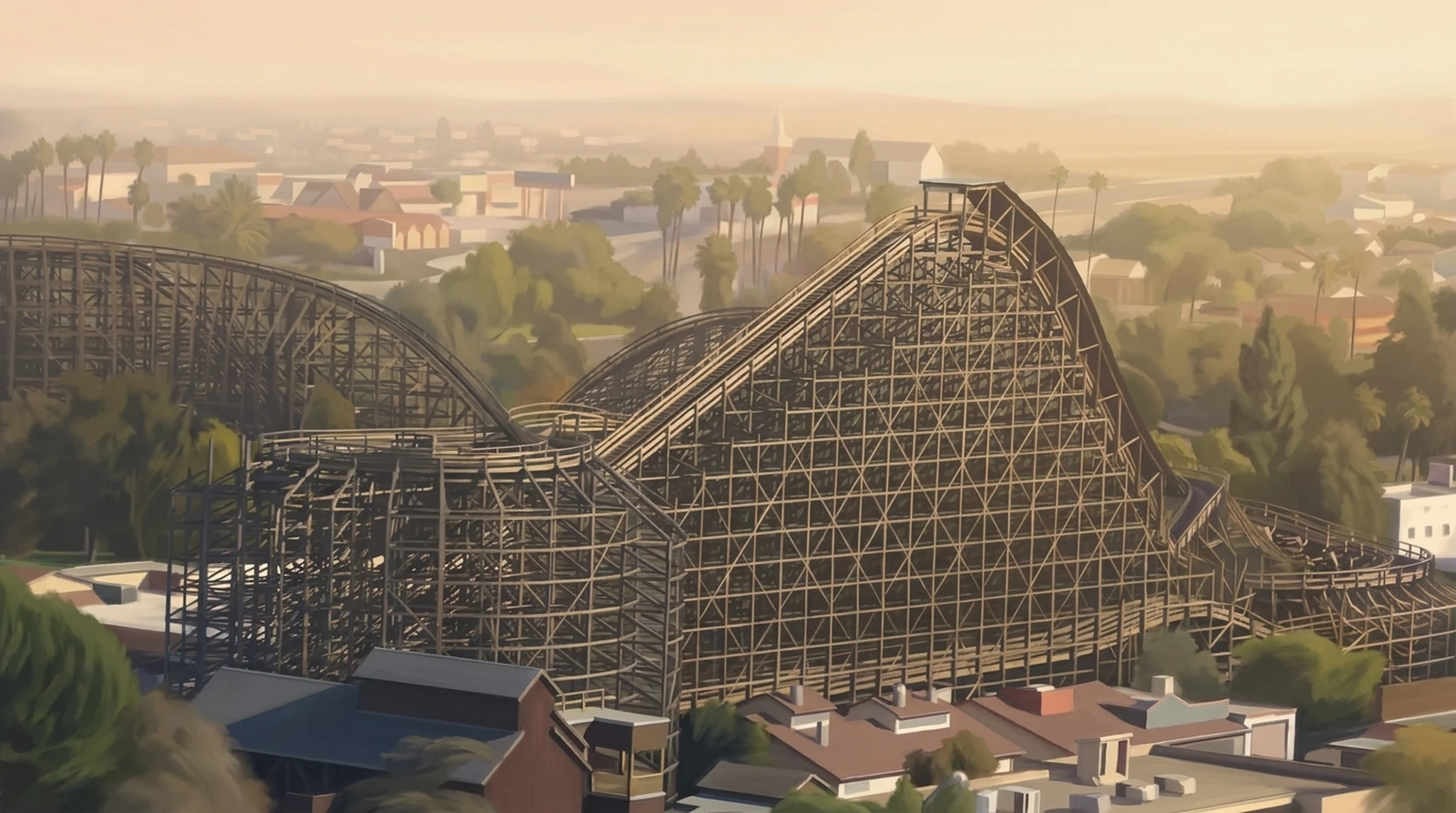
If you ask me what the best wooden coaster in California is, I don't really have to think about it, it's GhostRider at Knott's, and there isn't a close second among the woodies in this state. Where it lands once you open it up to everything California has? I'd put it third overall, behind Twisted Colossus and X2, both over at Six Flags Magic Mountain, and honestly those three are all close, not by much. The only things I rank ahead of GhostRider out here are two of the most technically ambitious steel coasters anywhere in the world, and even then the margin is tight enough that depending on the session I could talk myself into bumping it up.
And I stand by that ranking, because GhostRider earns its spot by just working you over the whole way through. At 4,533 feet it's the longest wooden coaster on the West Coast, and it uses every single foot of that. The double out-and-back layout keeps trading energy back into the train instead of dumping it all on one focal drop, so you step off feeling like the thing fought you the entire ride, because it did.
What happens out there
The chain lift tops out at 118 feet, which, look, isn't going to stop anybody's heart by today's standards, but the 108-foot first drop at 51 degrees gets the job done just fine. The speed shows up fast and it stays. GhostRider hits 56 mph and it just keeps that speed instead of shedding it after the first drop. You get 14 hills over a circuit that runs nearly three minutes, and that's really the whole character of the thing: relentless, consistent airtime and lateral pressure that never quite lets off.
The head-chopper moments down under the structure are their own kind of fun. The LA Times reviewer talked about leaning into drops while the restored coaster "zipped under head-chopper near misses and around switchback turns," and those near-misses hit even harder in the back rows, where the rear of the train is still cresting one hill while the front has already thrown itself at the next drop. Wooden coasters do that better than any steel ride out there, and GhostRider serves it up over and over.
But the real standout, the moment I'd point anybody to, is the drop where the mid-course brake run used to be. GCI tore those brakes out completely in the renovation, so the track just runs straight through where the ride used to catch its breath, and you hit that drop carrying every bit of speed the layout has built up. It's the most memorable single moment on the whole ride for me, more surprising than the first drop and more satisfying because of where it falls in the pacing. The back row cranks it way up, and that combo right there, back seat coming off that particular drop, is the version of GhostRider worth chasing. Absolute PEAK.
The closing helix into the magnetic brake run wraps it up clean. Like the LA Times reviewer put it, "the once-again unrelenting ride maintains its speed all the way through the last helix before coming to a smooth stop in the new magnetic brake run." Not every wooden coaster can honestly say that.
Why the renovation changed everything
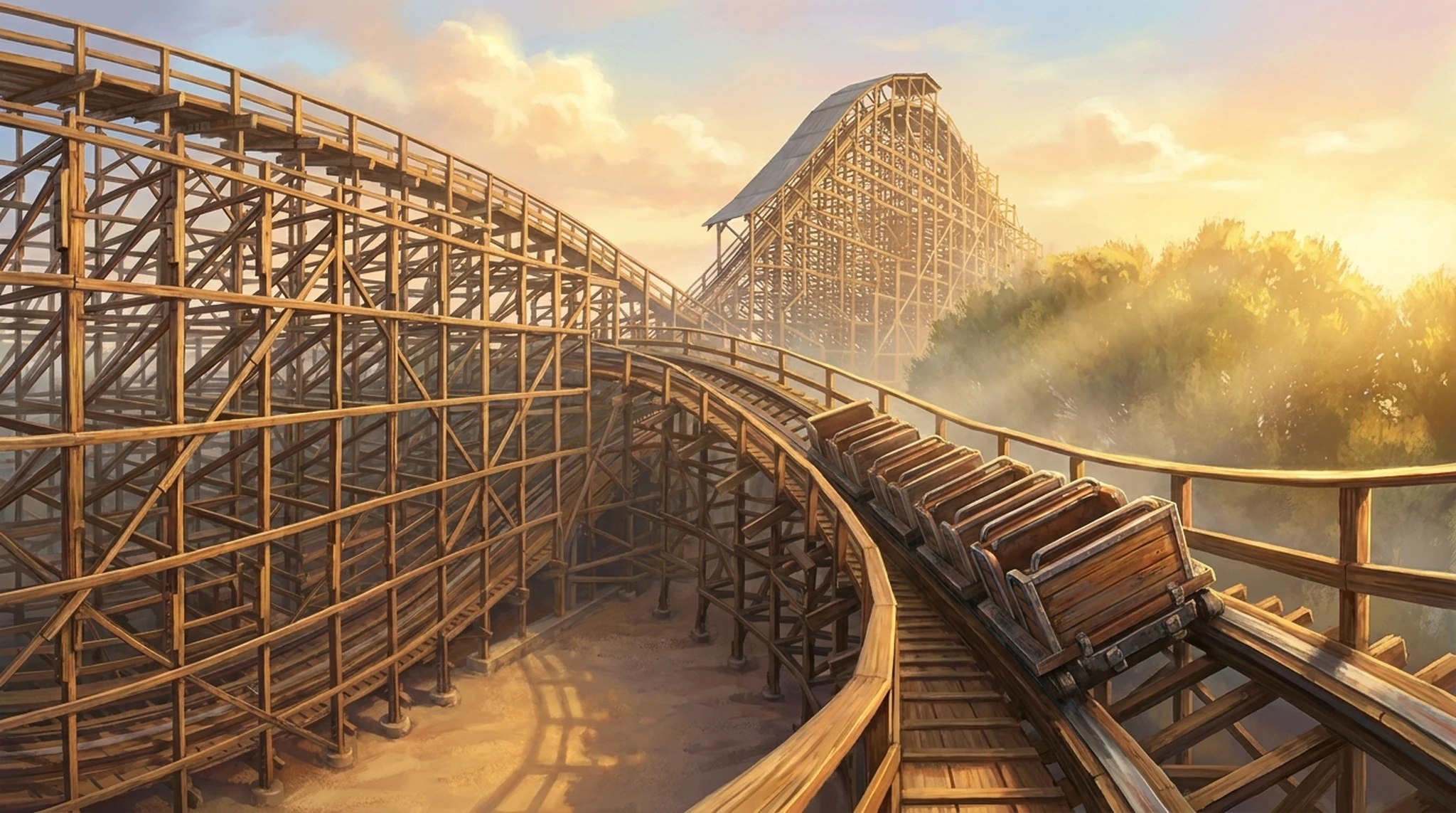
GhostRider opened on December 8, 1998, built by Custom Coasters International for $24 million, and for most of its first decade people loved it. Then the years caught up with it the way they catch up with a lot of wood. The steel supports they added to prop up the aging structure had the unintended side effect of making the ride rougher, and what used to be this fast airtime machine slowly turned into something people were calling "RoughRider." Enthusiasts straight up rode it less and less as it got rougher over the years.
Then Great Coasters International closed it down in September 2015 and spent the better part of a year replacing the entire track and swapping out the original Philadelphia Toboggan Company trains for GCI's Millennium Flyer cars. It reopened June 11, 2016, and the renovation also removed the mid-course brake run entirely, which under the old setup had been fully stopping the train to take stress off the tired wood, finally letting the layout run at the speed it was actually built for. Ever since, Amusement Today's Golden Ticket Awards has consistently ranked GhostRider among the world's top wooden coasters. And look, the GhostRider I'm reviewing here, the one I rank where I rank it, is built entirely on that comeback. Pre-2016, this is a completely different conversation.
What riders say
The thing you hear over and over is the same thing I keep coming back to, which is that night ride plus back row is the defining way to do this coaster. People on Reddit coming back to Knott's after a few years away talk about how much it changed from the pre-renovation days, and one recent trip report lines up with the wider community read that today's GhostRider is genuinely a different ride than it was before 2016. The CoasterCrazy park guide flags it as one of the first stops worth hitting right at park open, since the lines stack up fast as the day goes.
Even Knott's own description backs the night ride flat out: "For the ultimate thrill, ride at night when every twist and turn is hidden in darkness." And that's not just marketing fluff, I promise. Not seeing the transitions coming is a real factor on this layout, and the Ghost Town theming around it only adds to it. On a busy evening the whole atmosphere around the ride gives you something you just can't get riding it in broad daylight.
Where it stands in California
So where does it all land? Among California's wooden coasters, GhostRider is the clear top of the pile, and it isn't particularly close. Gold Striker and Apocalypse are both respectable rides, don't get me wrong, but neither one gives you the mix of length and that sustained, moment-to-moment pacing that GhostRider does in its post-renovation form. The re-track took a ride that was falling apart and turned it back into something that honestly holds its own against the best wood in the country, and for a 26-year-old wooden coaster, that just doesn't happen very often.
So when I stack GhostRider up against the whole California lineup, steel included, it comes in at number three, with only the two Magic Mountain heavyweights ahead of it, and the gap there is slim. Those two are doing something GhostRider isn't even trying to do, with Twisted Colossus and its synchronized dueling design and X2 and its fourth-dimension rotating seats, so they're playing a totally different game altogether. But a woodie sitting right on their heels is a genuine statement if you ask me, and holding that spot against modern steel tells you how well the original structure was thought out in the first place, and how much the GCI work brought it back.
Verdict
Ride it at night, in the back row, and if the line lets you, stay on for at least two laps. That first lap is really just to get your bearings on the layout, and the second is the one where you know that big plunge through the old mid-course section is coming and you can really feel what the back seat does with it, which for my money is the high point of the entire layout. The minimum height is 48 inches, and the smoothness after the renovation is genuine enough that even folks who got beat up by the pre-2016 version can give it another shot. As a wooden coaster, GhostRider is the best California has, no question. And as a coaster of any kind, steel or wood, it belongs on every serious enthusiast's California itinerary.
Banner image: based on a photo by METRO96 (CC BY-SA 4.0, via Wikimedia Commons), stylized by TrackR.