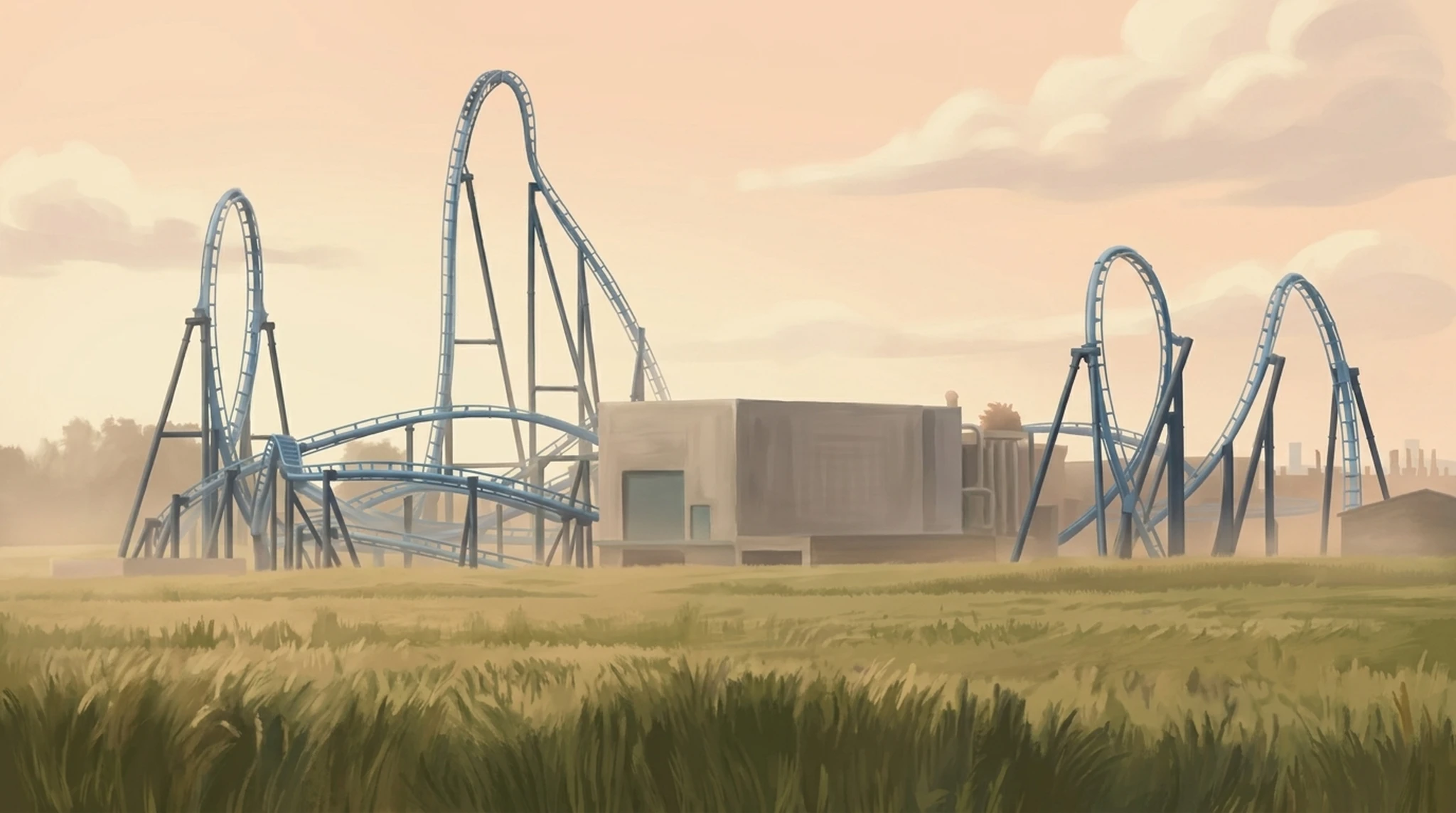
Abyssus is the kind of coaster that splits the opinion of the people who ride it. On paper it's exactly what an Energylandia headliner ought to be, a Vekoma Shockwave double-launch model that tops out at 62.1 mph across 4,317 feet of track, with four inversions and a layout Vekoma itself pitches as "high pacing" that "doesn't let up until the final turn". But out in the real world, riders coming back from the Aqualantis zone at Zator, Poland have landed on something a lot messier, and one thread on the roller coaster subreddit puts the harsh end of it about as bluntly as you can, calling it "a forgettable ride".
And that tension, a coaster that checks every technical box and still somehow doesn't stick with people, is the puzzle at the center of Abyssus. It isn't rough, and it isn't painful. The vest harness that coaster.cloud lists as the restraint is a modern unit, and current Vekoma hardware has mostly shaken off the bruising reputation those old shuttle-loop machines carried around. The thing riders keep circling back to is whether the layout actually earns the emotional punch the theme is reaching for.
The double launch: promise and execution
The headline mechanical trick here is the double LSM launch system. The first launch fires straight out of the station, and per Energylandia's own attraction page, the train hits its full 100 km/h in seconds. Then a second launch picks things up mid-ride "as it begins losing its speed," kicking the train back up before the back half of the layout unwinds. Vekoma built Abyssus with a patented active boost motor system, where the first pair of boosters reads the incoming train speed and the remotely controlled electromagnetic motors after them bring the train up to a set value and hold it there.
In theory that second launch is where Abyssus is supposed to separate itself from a plain old chain-lift coaster. Double-launched layouts hit hardest when the re-acceleration lands at a moment you don't see coming, grabbing you mid-slowdown and snapping you back into full speed. Whether Abyssus actually nails that moment is the exact thing that splits the room, and the riders who stack it up against Europe's meanest launched coasters keep coming back with the same read, that the build toward the second launch is more interesting than the payoff itself.
What the layout actually does
Once that first launch goes, the train climbs to 38.5 meters (126 feet) and gets to work on a four-inversion run. The confirmed elements, per RCDB and coaster.cloud, are a vertical loop, a batwing, and a corkscrew. The batwing earns its own mention, because that element runs you through a half-loop inversion, twists through a direction change, and spits you out through a second half-loop, which is why it stacks up two of the four counted inversions on its own. Done right, a batwing gives you this rolling, sustained disorientation that feels different from a standard loop. Vekoma describes the layout as packing "numerous inversions, airtime hills and forceful turns and twists", and the park claims peak g-forces of 4.5g.
The trip reports say that Abyssus has enough going on across its 1,316 meters to dodge the dead spots, and the layout just keeps moving. The intensity, though, is dialed in for a wide audience rather than the high-end enthusiast crowd, and the airtime tends toward quick little pops instead of the sustained floater stuff. Ride time runs from about a minute and twenty seconds to two minutes, which is a reasonable window for the amount of track you're covering.
The Aqualantis setting
Abyssus sits right at the center of Energylandia's Aqualantis zone, a themed land built around the myth of a drowned civilization. The ride is framed as a pump station thrown up over the ancient temple of the ocean god Abyssus, and the park's own description casts you as an explorer poking around the flooded ruins on small boats, right up until you provoke the deity and get swept into a shockwave. Jora Vision Europe, the Dutch design firm, handled the theming work after first showing off the Aqualantis concept publicly at the IAAPA Expo Europe in Paris in September 2019. The ride works in water effects too, waterfalls and fountains that play off the track at key moments, and on a warm afternoon those effects add real texture to the experience instead of just sitting there as decoration. Whether the whole thing pulls together into something genuinely immersive is a fair thing to ask, since Energylandia runs as a coaster-dense European park rather than a narrative-first destination, and the riders who walk into Aqualantis on those terms tend to come away impressed by regional standards.
How the ride got here
Abyssus didn't happen by accident, and the backstory tells you how much Energylandia was betting on it: the park chased EU ESI funding back in September 2017 to bankroll a big new steel coaster. Plans for the double-launch Vekoma got confirmed in a December 2018 issue of the German trade magazine Kirmes Park & Revue, aiming for a 2020 opening. Then COVID-19 shoved the timeline back by more than a year, with Abyssus soft-opening on July 10, 2021, and officially debuting on July 14 alongside the full Aqualantis area. The total build cost landed at €11 million, and it became Energylandia's 17th roller coaster. That aggressive EU-backed expansion is really the whole reason this ride exists, because Energylandia went from a modest regional spot to one of Poland's major coaster destinations in under a decade, and Abyssus was built to be the centerpiece of Aqualantis.
What riders actually say
If you've read enough park reviews, the way folks talk about Abyssus probably won't surprise you. The riders who show up with sky-high expectations, especially the ones holding Abyssus up against the most intense European launched coasters, tend to walk off calling it competent without ever calling it electric. That "forgettable" label keeps making the rounds in enthusiast spaces, and it's the tag that gets pinned on coasters that hit every element cleanly but never quite generate the kind of physical punch that makes you want to run right back around. So if you're a rider chasing crushing sustained forces or those long, drawn-out negative-g moments, the read from the community is that Abyssus, even while it pushes up to 4.5g, got tuned for a general audience rather than the committed thoosie bracket.
On the flip side, the riders who set their expectations to a family-to-enthusiast crossover, a well-paced double launch with legitimate speed and real inversions sitting inside a nicely realized themed environment, are the ones who come away grinning. And the capacity of 1,000 riders per hour across three trains means that the waits, while they're definitely there during peak hours, rarely turn into the thing that wrecks your day.
The practical verdict
Abyssus is the right ride for guests who want a genuine thrill in a themed setting and aren't specifically out hunting for the single most intense launched coaster on the continent. That double-launch structure gives you two distinct hits of acceleration instead of one sustained burn, and that's what keeps the layout feeling dynamic the whole way through. The modern vest harness is comfortable. And honestly, the Aqualantis area earns a walk-through all on its own, coaster or no coaster.
Riders who prize sustained intensity or relentless airtime are the ones most likely to walk off underwhelmed, and we'd be lying if we pretended otherwise. From what we've gathered, enthusiasts broadly lean toward the front-row seats for the wide-open views of the Aqualantis area and the cleaner feel through the inversions, though the back rows can crank up that launch sensation if raw acceleration is what you're after. Going early in the day gives you the best odds against the midday queues on a ride working with 16-person-per-train capacity.
So look, Abyssus is a capable, well-built coaster from a manufacturer that's in genuine creative form right now. It's also a ride that's just a lot more fun when you take it for what it actually is instead of what you were hoping it'd be.